For all naysayers who dismiss historical Technocracy as just coincidental to modern events, get your head out of the sand. Courtenay and I have blown the top off of Technocracy. The arc of history proves it, and it is as bat-quano-crazy today as it was in 1932, when it crystallized at Columbia University. Even Marxists/Communists denounced Technocracy in the 1930-1940s as anti-human. ⁃ Patrick Wood Editor.
Universal HIGH INCOME via checks issued by the Federal government is the best way to deal with unemployment caused by AI.
AI/robotics will produce goods & services far in excess of the increase in the money supply, so there will not be inflation.
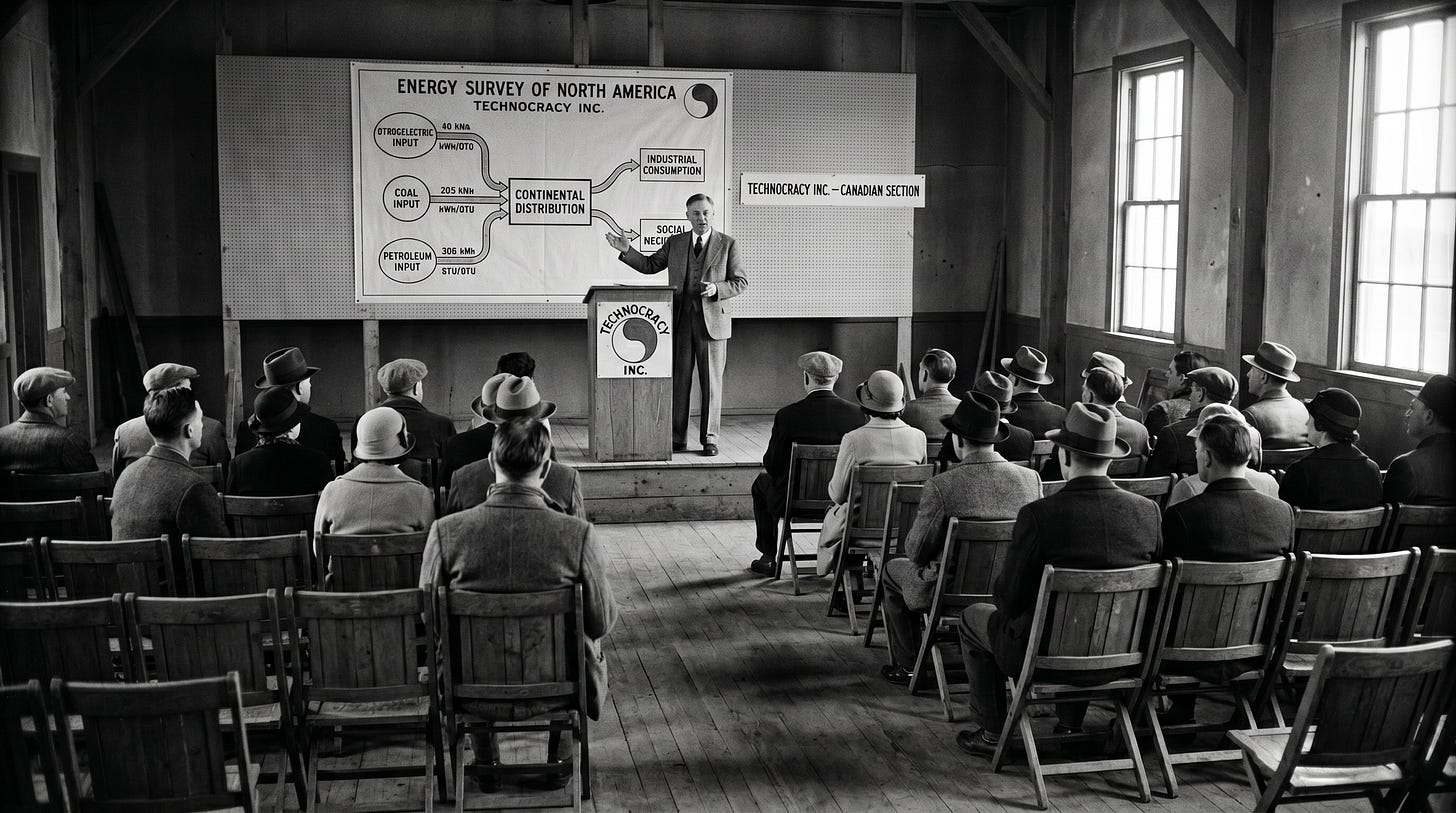
The ideological genealogy of Elon Musk’s proposed “Universal High Income” remains conspicuously underexamined in contemporary discourse. Musk’s maternal grandfather, Joshua N. Haldeman, served as a principal organizer of Technocracy Incorporated’s Canadian operations during the 1930s — a techno-rationalist movement that sought to abolish the price system entirely, replacing monetary exchange with energy certificates: universally distributed allotments calibrated to continental energy production, allocated to every citizen irrespective of employment status, and administered by a technocratic governing body of engineers — a so-called Technate — entirely insulated from democratic politics and market mechanisms.
The movement’s trajectory in Canada was abruptly curtailed when the federal government banned Technocracy Inc. at the outset of the Second World War under the Defence of Canada Regulations, citing its opposition to conscription and perceived subversive character, including its authoritarian, anti-democratic structure. The group’s public posture was anti-communist and framed as patriotic, though Technocracy’s uniformed organization, stylized salutes, and opposition to parliamentary democracy drew contemporary comparisons to fascism — comparisons later reinforced by Haldeman’s son-in-law Errol Musk, who claimed in 2024 that Haldeman had sympathized with Nazi Germany during the war. Subsequently, he redirected his political energies toward the leadership of the Social Credit Party in Saskatchewan — a parallel reform tradition premised on monetary dividends and the redistribution of credit to citizens as a function of aggregate social productivity, which itself faced accusations of antisemitic conspiracy theories in certain organizational circles.
Black-and-white photograph of a sparsely attended Technocracy Inc. meeting in a municipal hall, 1930s. A speaker stands at a lectern beside a hand-drawn flow diagram of continental energy production.
The pattern was not merely organizational but personal: when the party’s Quebec wing published excerpts from the Protocols of the Elders of Zion in the mid 1940’s, Haldeman publicly disavowed antisemitism while simultaneously delivering a speech defending a party newspaper’s publication of the Protocols, arguing that their authenticity was beside the point — the plan as outlined in them, he said, had been ‘rapidly unfolding in the period of observation of this generation‘. The rhetorical structure of that maneuver — formal denial concurrent with substantive endorsement, issued under conditions of political exposure — finds an uncomfortable echo in his grandson’s 2024 Auschwitz visit and apology, delivered in the wake of an advertiser boycott, after Musk had described a post promoting the “white genocide” conspiracy theory as “actual truth.”
That Haldeman’s disavowal was issued against a document already exposed as Tsarist secret-police fabrication — publicly debunked in The Times as early as 1921 — makes the equivocation harder to read as ignorance and easier to read as bad faith: a formal concession to propriety while preserving the conspiracy’s operative content. The structure recurs. When Musk’s November 2023 endorsement of the “great replacement” theory triggered an advertiser boycott, his response followed the same logic: a targeted crackdown on unrelated speech, an Auschwitz visit, a published apology — followed, within months, by an escalating feud with the ADL and a platform whose own AI was generating antisemitic content. In both cases, the disavowal was calibrated to the cost of exposure rather than to the substance of the claim.
Contemporary Resonance
Desaturated interior photograph of a hyperscale data center, long parallel rows of black server racks receding toward a vanishing point, a single technician in a utility vest standing among them for scale.
The structural continuities between this historical precedent and present-day proposals are striking. Musk’s “Universal High Income” — a program of unconditional government transfers predicated not on labor but on the productive surplus generated by artificial intelligence and automation — bears a conspicuous resemblance, at the level of political-economic architecture, to Technocracy Inc.’s energy certificate schema. Divested of contemporary branding, both models instantiate a form of conditionally metered, universally distributed allotment embedded within what systems theorists might recognize as a cybernetic infrastructure: a sociotechnical organism in which human agents and machinic systems constitute a single integrated productive unit.
The word ‘universal’ in both proposals does political work it cannot sustain under scrutiny. What is universal is the eligibility; what is conditional — and in both cases consequentially so — is everything else: the magnitude of the allotment, the criteria by which it is adjusted, the administrative body empowered to make those adjustments, and the productive infrastructure whose outputs determine what is available to distribute in the first place. A cybernetic organism has feedback loops, and whoever controls the loops controls the ‘universal’ distribution downstream of them. What Technocracy Inc. proposed as energy certificates and what Musk proposes as Universal High Income are, in this precise sense, not unconditional citizen dividends but conditionally metered allotments internal to a sociotechnical system — payments whose universality is nominal and whose conditionality is structural.
The structural kinship between Technocracy’s Technate and Musk’s Universal High Income comes into sharper focus when placed alongside the twentieth century’s most ambitious attempt to operationalize cybernetic governance: Stafford Beer’s Project Cybersyn, commissioned by Salvador Allende’s government in 1971 and dismantled with the Pinochet coup in September 1973. Beer, a British management cybernetician trained in the traditions of Ross Ashby and Norbert Wiener, designed Cybersyn as a real-time economic nervous system — a network of telex machines feeding production data from nationalized industries into a central Operations Room in Santiago, where a small team of engineers could adjust inputs, model outcomes, and stabilize the economy through continuous feedback. The Operations Room itself, with its seven Tulip chairs and hexagonal screens, was designed as the visual embodiment of what Beer called the Viable System Model: a sociotechnical organism in which human and machinic processes constitute a single self-regulating unit.
Cybersyn is the missing middle term between Scott’s 1930s energy-certificate Technate and the contemporary Silicon Valley imaginary of algorithmically administered abundance. Evgeny Morozov’s 2023 podcast The Santiago Boys has documented how the Cybersyn legacy runs, via its surviving participants and their students, into the present-day technocratic imagination; Beer’s own later work on the Viable System Model and on “syntegrity” became one of the explicit reference points for the Game B discourse that emerged in the 2010s around Jordan Hall, Bret Weinstein and Jim Rutt, a lineage that draws equally on Beer’s cybernetics and on Ilya Prigogine’s thermodynamics. Allende’s cyberneticians and Scott’s technocrats began from opposite poles of the political compass and arrived at strikingly similar architectures: centralized technical administration of a productive system whose outputs are distributed to citizens by rule rather than by market.
Any genealogy of contemporary technocratic thought that stops at Musk understates the network effects. Peter Thiel — Musk’s PayPal co-founder, Palantir chairman, and Founders Fund principal — has articulated, in Zero to One (2014) and in his 2009 Cato Unbound essay “The Education of a Libertarian,” a vision in which “definite optimism” and founder-led corporations supersede democratic deliberation as the legitimate engines of civilizational advance.
Thiel’s now-notorious assertion that he no longer believes freedom and democracy are compatible functions as the right-accelerationist tradition’s clearest policy statement: the democratic franchise is treated as an impediment to the technically competent administration of the future, and the entrepreneur-founder is installed as the successor sovereign. Chris McGreal’s January 2025 reporting in The Guardian, along with his subsequent Democracy Now interviews, situated the PayPal mafia’s political dispositions in the same apartheid-era Southern African milieu that shaped Musk and his grandfather. Thiel spent part of his childhood — roughly 1971 to 1977 — in South Africa and then South West Africa, attending a German-language school in Swakopmund during a period when the town was still, as McGreal put it, a place where ‘Heil Hitler’ greetings remained in open use. The experience is one Thiel himself has cited in linking his later libertarianism to a reaction against the school’s discipline; critics have noted that the surrounding apartheid and colonial context is not incidental to the political vision he later developed.
The Thielian contribution, overlaid on the Haldemanian inheritance, clarifies something about the current configuration: where Haldeman’s Technocracy proposed engineer-administrators and Musk’s UHI proposes federally distributed abundance, Thiel’s variant proposes founder-sovereigns whose corporate vehicles become the operative units of governance — a convergence that Curtis Yarvin has theorized explicitly under the rubric of “neocameralism” and that Nick Land, in his Dark Enlightenment phase, endorsed as the logical endpoint of post-democratic accelerationism. The three figures — Haldeman, Musk, Thiel — do not represent a single doctrine, but they do represent three successive answers to the same question: who governs when politics is held to have failed?
Accelerationist Frameworks
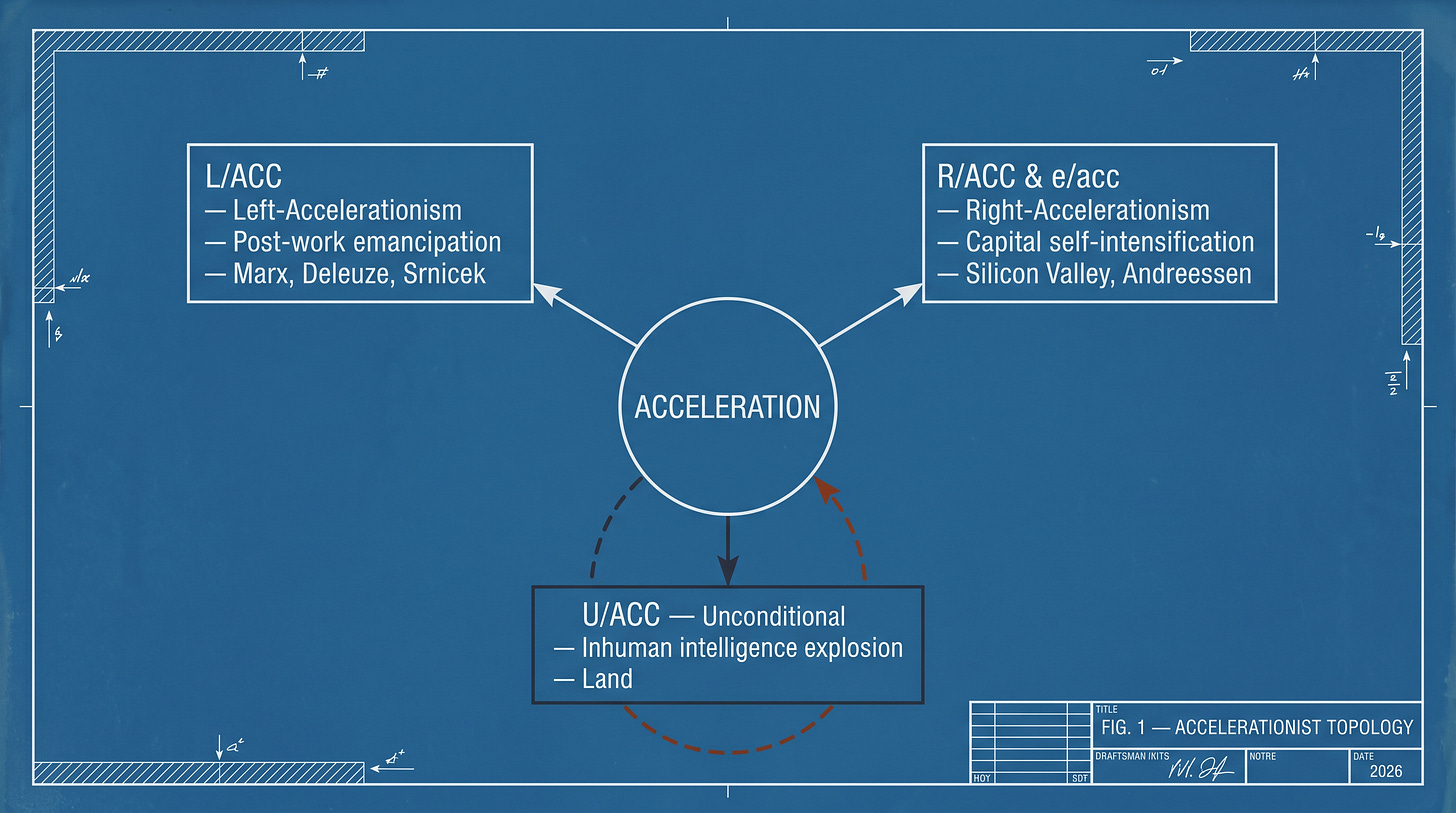
Blueprint-style diagram titled “Fig. 1 — Accelerationist Topology.” A central node labeled ACCELERATION branches into three labeled boxes: L/Acc (post-work emancipation), R/Acc and e/acc (capital self-intensification), and U/Acc (inhuman intelligence explosion). A recursive arrow loops from U/Acc back to the center.
To adequately theorize this convergence, it is necessary to distinguish carefully between three discrete — and at points mutually antagonistic — strands within accelerationist thought, as the differences between them are not merely stylistic but structurally determinative.
Left-Accelerationism (L/Acc) has its intellectual roots in a broadly Marxist orientation. Drawing on thinkers from Marx’s Fragment on Machines through to Deleuze and Guattari’s Anti-Oedipus, L/Acc argues that the productive forces unleashed by capitalist technoscience ought to be accelerated toward rather than resisted or retreated from — not to vindicate capitalism, but to exhaust and supersede it. The goal is the generation of material conditions sufficient for a post-work society of automated abundance, a position crystallized most provocatively in the slogan Fully Automated Luxury Communism. On this account, technology is a terrain of political contestation and potential emancipation: the task is to repurpose and redirect the machinic surplus of capitalism toward collective, egalitarian ends.
The Haldemanian-technocratic imaginary shares this common telos — the emancipation of human beings from compulsory labor through the administrative rationalization of machinic productivity — even as it reaches it through an entirely different political tradition.
Right-Accelerationism (R/Acc) and its more recent, Silicon Valley-inflected variant Effective Accelerationism (e/acc) represent a fundamentally different appropriation of accelerationist logic. Where L/Acc deploys acceleration in service of post-capitalist transformation, R/Acc and e/acc embrace acceleration as capitalism’s self-intensification: unregulated markets, exponential technological growth, and the dissolution of political constraints on innovation are treated not as instruments toward a further end but as intrinsically valuable processes. The e/acc variant in particular — prominent in venture capital and AI development circles, and articulated explicitly by figures such as Guillaume Verdon (“Beff Jezos”) through a vocabulary of thermodynamic computing and non-equilibrium dissipative dynamics borrowed directly from Prigogine — tends toward a techno-optimist voluntarism in which founders, builders, and investors are cast as the vanguard of civilizational progress. This strand is politically heterodox but broadly comfortable with market primacy, techno-managerial governance, and, notably, with proposals like universal income as a mechanism for managing the social disruptions of automation.
The Land Paradox
The constitutive irony of this entire configuration becomes sharpest when one returns to Nick Land — the thinker whom right-accelerationists most frequently invoke as the field’s intellectual patriarch, despite the fact that his own theoretical trajectory renders that invocation deeply paradoxical.
It is crucial to note that Land himself began from the left: his early work at the University of Warwick in the 1990s, produced within the Cybernetic Culture Research Unit (CCRU), drew heavily on Marxist political economy, Deleuze and Guattari, and a broadly anti-humanist critical theory. His initial accelerationism was, in important respects, a radicalization of the L/Acc impulse — an attempt to push the logic of capitalist deterritorialization past any point of political recuperation. It was only through a sustained theoretical radicalization that Land’s position migrated toward what is now termed Unconditional Accelerationism (U/Acc).
Grainy 1990s photograph of an empty, cluttered university philosophy office. A cluttered desk with a CCRU pamphlet, a glowing green CRT monitor, and metal shelves of continental theory paperbacks. A chalkboard behind the desk is covered in handwritten rhizomatic diagrams and the words “deterritorialization” and “capital=AI.”
U/Acc– unconditional accelerationism represents Land’s explicit rejection of both L/Acc and R/Acc as theoretically incoherent. For Land, both tendencies remain guilty of a foundational “human delusionalism”: the epistemically naïve assumption that human agency, human welfare, or human ideological preference constitutes either the motor or the terminus of accelerative processes. L/Acc, on this account, merely substitutes a left-humanist telos for a capitalist one — it still imagines acceleration as a tool in human hands, directed toward human flourishing. R/Acc and e/acc, despite their rhetoric of chaos and anti-regulation, similarly presuppose human entrepreneurs and institutions as meaningful agents steering the process. For Land, genuine acceleration names an inhuman intelligence explosion that does not merely exceed human governance but renders the very category of human centrality — whether socialist or libertarian in inflection — theoretically obsolete.
It is worth noting that Land’s own 2012 essay The Dark Enlightenment — the text from which the broader neoreactionary (NRx) movement takes its name, and which Land himself coined as a label — was structured explicitly as an extended commentary on Curtis Yarvin’s Mencius Moldbug writings, and is therefore downstream of Yarvin on the specific question of corporate sovereignty and neocameralism. The ordering matters: Land coined the Dark Enlightenment label, but the operative neocameralist proposal it endorses originates with Yarvin, whom Land endorsed precisely because he read Yarvin’s corporate-sovereign model as more honest than L/Acc or R/Acc about the end of democratic humanism (which includes constitutional republics).
The resulting paradox is theoretically significant: substantial segments of the right-accelerationist and e/acc milieu invoke Land as a founding authority while simultaneously advocating techno-managerial welfare architectures — including, one might argue, Musk’s own Universal High Income — that Land’s framework would classify as humanist impediments: regulatory and redistributive dampeners applied to a process that, by hypothesis, cannot and should not be governed in the interests of any human constituency.
That Joshua Haldeman’s technocratic vision — suppressed as politically dangerous in the 1940s — finds structural echo in both the policy proposals of his grandson and the post-work imaginaries of contemporary accelerationist theory suggests that what presents itself as radical futurism may, in fact, be the periodic resurgence of a far older political-technological unconscious: one in which the dream of replacing democratic deliberation with engineered administration of abundance keeps returning, in each generation, wearing new theoretical clothes.
Two identical archival document boxes on a grey archive table. The left box is labeled “Haldeman Family Papers, 1932–1948, Technocracy Inc. Materials.” The right box is labeled “Policy Proposals, 2024–2026, Universal High Income.” A single uncatalogued manila folder rests between them.
Two Cybernetic Lineages, One Silicon Valley
What makes the contemporary configuration genuinely novel — and what the Haldeman-Musk genealogy alone cannot fully explain — is that two historically opposed cybernetic traditions have been quietly fused in the political imagination of the contemporary tech right.
The first is the top-down Technocracy lineage this essay has already traced: Howard Scott’s energy certificates, Haldeman’s Technate, Stafford Beer’s Operations Room, Musk’s Universal High Income — a tradition in which a technically competent administrative body meters the distribution of a productive surplus to a population whose labor has become economically redundant.
The second is a bottom-up lineage that runs through an entirely different intellectual watershed: Ilya Prigogine’s work on dissipative structures and far-from-equilibrium self-organization in the 1970s — which earned him the 1977 Nobel Prize in Chemistry — provided the thermodynamic grammar for the Santa Fe Institute’s founding program in complexity science in 1984: Brian Arthur on increasing returns and lock-in, Stuart Kauffman on autocatalytic networks, Doyne Farmer on market dynamics. This conceptual toolkit migrated, through the cypherpunk milieu of the 1990s (Tim May, Nick Szabo, Hal Finney), into the architecture of Bitcoin, decentralized autonomous organizations, and the broader crypto imaginary. Swarm intelligence, distributed consensus, emergent coordination without central authority: where the first lineage proposes an engineer-sovereign, the second proposes no sovereign at all, only a self-organizing protocol. The Game B discourse associated with Jordan Hall, Jim Rutt, Bret Weinstein and Forrest Landry — itself saturated with Prigoginean vocabulary, as the Game B wiki openly acknowledges — represents one recent attempt to articulate a synthesis between these traditions from the left-adjacent direction.
The figures who now dominate the contemporary tech right represent the same synthesis from the other direction. Musk advocates federal UHI checks (top-down technocratic administration) while simultaneously championing Dogecoin, pursuing an “everything app” payments strategy for X, and operating Starlink as a globe-spanning distributed network (bottom-up distributed infrastructure). Thiel holds Palantir — whose core products are comprehensive data-integration and surveillance-analytic platforms for state and corporate clients — alongside vocal public advocacy for Bitcoin and Founders Fund’s substantial crypto portfolio. Figures in and adjacent to the e/acc milieu cite Land (autonomous techno-capital as self-organizing process) while simultaneously endorsing founder-sovereignty and, in Musk’s and Sam Altman’s cases most explicitly, state-administered welfare architectures to manage AI-driven labor displacement.
These pairings are schematic, and each figure resists them at the edges — but the pattern, across the cluster, is legible enough to be worth naming. What it names is not an incoherence being papered over but a genuine fusion, and that fusion has begun to acquire an institutional form. Curtis Yarvin’s neocameralist proposal — variously rendered as “gov-corp” in his 2007 A Formalist Manifesto and as “sovcorp” in the more elaborated Unqualified Reservations writings that followed — reframes the sovereign as a joint-stock corporation, citizens as customers, and exit rights as the substitute for democratic voice. Land endorsed the framework in The Dark Enlightenment (2012) as the honest terminus of post-democratic accelerationism.
Balaji Srinivasan’s The Network State (2022) supplies the operational bridge: a proposal in which an online community, cryptographically coordinated and territorially diffuse, crowdfunds land, negotiates diplomatic recognition, and bootstraps itself into sovereign existence — cypherpunk-bottom-up in its coordination mechanics, Yarvinite-top-down in its teleology. A network state is, in effect, a Yarvinite sovcorp instantiated through swarm-coordination protocols rather than through inheritance or conquest; it takes the crypto and DAO toolkit forged in the Prigoginean-cypherpunk lineage and uses it to build the Technate. The adjacent charter-cities tradition — Patri Friedman’s seasteading initiatives, the Honduran charter-city project Próspera (substantially Thiel-funded), Dryden Brown’s Praxis, the broader free-private-cities milieu — represents the same fusion pursued through the legal mechanism of special economic zones and corporate administrative enclaves rather than through network-coordinated statehood.
For Land, the neocameralist variant theorized in The Dark Enlightenment represents the only honest resolution to the accelerationist dilemma: abandon the humanist dampeners of both the welfare-administrative tradition and the democratic-market tradition, and let the autonomous techno-commercial process find its own attractor without human-interest adjudication. The irony, from a Landian perspective, is that his own contemporary readers in e/acc and Silicon Valley have declined the honesty. They have kept the aesthetic of bottom-up emergent order while quietly reimporting the administrative apparatus of the Technate — and the network state and the charter-cities / free-private-cities milieu, along with the Yarvinite gov-corp/sovcorp framework that underwrites both, are precisely the institutional vessels in which that reimportation is being carried out.
They have done so at precisely the moment when the grandson of a Canadian Technocrat, now the wealthiest private actor in history, proposes that the federal government begin issuing universal checks. What the Haldeman inheritance makes visible is that the political-technological unconscious structuring these proposals is not new; what the Srinivasan-Yarvin-Thiel convergence makes visible is that the unconscious has acquired, for the first time, the capital, the network, and the legal creativity to attempt its own materialization.
An Older Dream
That Joshua Haldeman’s technocratic vision — suppressed as politically dangerous in the 1940s — finds structural echo in both the policy proposals of his grandson and the post-work imaginaries of contemporary accelerationist theory suggests that what presents itself as radical futurism may, in fact, be the periodic resurgence of a far older political-technological unconscious: one in which the dream of replacing democratic deliberation with engineered administration of abundance keeps returning, in each generation, wearing new theoretical clothes. That this dream is now being articulated by figures who simultaneously champion its opposite — the cypherpunk fantasy of a fully decentralized, stateless, self-organizing digital commons — is not a contradiction so much as a confession. When politics is held to have failed, what remains is not a single replacement but a sequence of them, each borrowing legitimacy from the next: the Technate, the Founder, the Protocol. The question my work keeps returning to — who benefits, who decides, who is counted as human in the system being built — is the question it appears these successive substitutions are designed not to answer.
Joseph C. Keating and Scott Haldeman, “Joshua N Haldeman, DC: the Canadian Years, 1926–1950,” Journal of the Canadian Chiropractic Association 39(3), September 1995: https://pmc.ncbi.nlm.nih.gov/articles/PMC2485067/
Philip Graves, “The Truth About ‘The Protocols’: A Literary Forgery” (The Times, August 16–18, 1921), booklet reprint via Internet Archive: https://archive.org/details/bib_fict_4173308
Terminological note: Yarvin’s proposal is variously labeled “gov-corp” in his 2007 “A Formalist Manifesto” and “sovcorp” in his later Unqualified Reservations essays; the terms refer to the same underlying neocameralist framework, with “sovcorp” becoming canonical in neoreactionary discourse.
Balaji Srinivasan, The Network State: How to Start a New Country (self-published, July 2022): https://thenetworkstate.com/
Patrick Wood is a leading and critical expert on Sustainable Development, Green Economy, Agenda 21, 2030 Agenda and historic Technocracy. He is the author of Technocracy Rising: The Trojan Horse of Global Transformation (2015) and co-author of Trilaterals Over Washington, Volumes I and II (1978-1980) with the late Antony C. Sutton.