Humanoid Robots Enter The Workforce. How Long Before Workers Revolt?

Please Share This Story!
Listen to this article:
0:00
0:00
What Technocrats can’t understand is that people are not machines. When the populace rises up to stop them, Technocrats will be shocked, since they thought everyone would cheer them for helping humanity. It never occurred to them that anyone would have another view. This mechanistic, narcissistic worldview hasn’t changed in almost 100 years.

As I wrote in The Economics of Technocracy: You Will Own Nothing,

The Technocrat’s narcissism is not the flamboyant, attention-seeking variety. It is the cold, cerebral narcissism of the person who genuinely believes their superior knowledge places them above the moral framework that governs everyone else. This is closer to what psychologists call grandiose covert narcissism — the quiet certainty that ordinary people simply cannot comprehend what needs to be done.

What separates the technocratic personality from a garden-variety authoritarian is the absence of passion. The dictator wants power and knows it. The technocrat wants control and calls it management. There is no rage, no vendetta, no ideological fervor in the traditional sense; just the calm, procedural conviction that the system must be optimized and they are the ones to do it.

This is also what makes it so difficult to oppose. You can fight a tyrant. You can argue with an ideologue. You can debate a philosopher. But how do you resist someone who doesn’t believe they’re doing anything to you — who sees your objections as merely a symptom of your failure to understand the process?

That maps directly back to the Borg: “Your consent is irrelevant.” ⁃ Patrick Wood, Editor.

The emergence of the humanoid robotics industry worldwide continues to gather pace. UBS analyst Phyllis Wang noted some of the most recent developments:

  1. The 2026 Beijing Humanoid Robot Half-marathon Race reflected the advancement of hardware technology;
  2. We are seeing financing accelerate among some companies, including several OEMs focusing on robotics AI and key component manufacturers (such as dexterous hands). For example, TARS has completed a pre-A funding round of US $455m. Local governments, industrial funds and industry leaders are all actively deploying the robot track.
  3. Data collection channels are becoming more diverse, including direct collection from implemented applications, data collection centres and robot rental. During Tesla’s Q1 earnings call, management mentioned that it may unveil Optimus Gen 3 in late July or August, closer to the start of production, citing concerns over competitors copying its designs.

Earlier this year, Wang penned a note to the client outlining that shipments and deployments of humanoid robots on factory floors would gather pace this year and really ramp in 2027.

“For 2026, our base case forecast for global humanoid robot demand is 30,000 units. Regardless of total output in 2026, we expect a small proportion of robots which can complete simple tasks autonomously outside entertainment and robot training scenarios, given the gap between robot intelligence and customer needs,” Wang told earlier this week.

He continued, “We flag upside risk to our 2027-28 demand forecasts if robots used in industrial settings make significant progress. While humanoid products are still evolving, several leading OEMs are planning and deploying production capacity.”

“Tesla plans to build a 1m unit Optimus robot production line with production starting at end-2026. UBTECH plans a production capacity of 10,000 units this year, while Boston Dynamics (BD) plans a 30,000 unit capacity in 2028 for its Atlas robot,” he added.

For the latest deployments, Japan Airlines appears to have launched a humanoid robotics pilot program to address the labor shortage in airport ground-handling operations, according to the flight news website Flight360aero.

“This is the first initiative of its kind in Japan to address the worsening labor shortage. Initially, the experiment will test the robots moving cargo containers from trolleys to near the aircraft. The airline is considering putting the robots into practical use from 2028 onwards,” the outlet said.

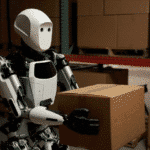
As humanoid robot shipments ramp in the coming quarters, expect a steady stream of viral footage showing these robots replacing lower-skilled labor across warehouses, factories, retail, logistics, and service jobs.

The real question is: when does the backlash begin?

Just as the data center revolt erupted once folks saw their power bills soar, a robot revolt could follow once workers see humanoids moving from funny tech demo promotional videos onto factory floors.

Read full story here…

Popular posts

About the Editor

Patrick Wood
Patrick Wood is a leading and critical expert on Sustainable Development, Green Economy, Agenda 21, 2030 Agenda and historic Technocracy. He is the author of Technocracy Rising: The Trojan Horse of Global Transformation (2015) and co-author of Trilaterals Over Washington, Volumes I and II (1978-1980) with the late Antony C. Sutton.
Subscribe
Notify of
guest

0 Comments
Oldest
Newest Most Voted
Inline Feedbacks
View all comments