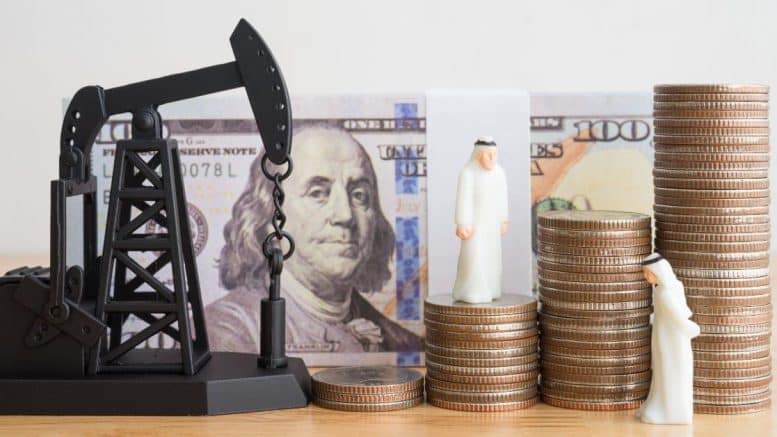
Boom! United Arab Emirates Exits OPEC: The End Of The Petrodollar And The Rise Of IMEC

Please Share This Story!
Listen to this article:
0:00
0:00

History has just been made. The Petrodollar is dead. Asset tokenization will replace the dollar when pricing oil. The IMEC corridor is rebooted with or without the Strait of Hormuz. All of this at the hands of the UAE, the balance of power in the Middle East has shifted. This validates my new book, The New Economics of Technocracy.

On April 28, 2026, the United Arab Emirates announced its withdrawal from OPEC, effective May 1, ending nearly six decades of membership in the oil cartel that has governed global energy markets since 1960. The announcement was brief. The implications are historic. What the UAE did on that date was not merely resign from an organization. It served formal notice that the architecture of global energy commerce — the petrodollar system that has underwritten American financial hegemony since the Nixon era — is being dismantled and replaced.1

The timing tells the story. The Strait of Hormuz has been under effective Iranian blockade since February 28, 2026, when the United States and Israel launched Operation Epic Fury against Iran and assassinated Supreme Leader Ali Khamenei. Tanker traffic through the Strait dropped approximately 70 percent. Oil prices shattered the $100-per-barrel threshold. The ceasefire negotiations that followed have been a rolling catastrophe — agreements made and immediately broken, tolls demanded, mines in the water, and a U.S. naval blockade of Iranian ports creating what analysts have called a “dual blockade.” Against this backdrop, the UAE did not wait for resolution. It moved.

The UAE’s exit is not an act of panic. It is the culmination of a decade of deliberate strategic positioning — in infrastructure, in finance, in artificial intelligence, and in the emerging Technocratic architecture I have been documenting for years. Understanding why the UAE wins regardless of how the Hormuz crisis resolves, and why its departure from OPEC accelerates the IMEC corridor project that Trump has called “one of the greatest trade routes in all of history,” requires seeing all the pieces simultaneously.

A Cartel Built for a World That No Longer Exists

OPEC was not merely a producers’ club. It was the institutional backbone of the petrodollar system — the arrangement, constructed in the early 1970s after Nixon closed the gold window, by which oil was priced and settled in U.S. dollars globally. Every nation on earth that needed oil had to hold dollar reserves to buy it. That perpetual demand for dollars allowed Washington to finance deficit spending across decades without the inflationary consequences that would otherwise have followed. OPEC was the guarantee mechanism. So long as its members priced in dollars, the dollar remained irreplaceable.

The UAE joined OPEC in 1967 through the emirate of Abu Dhabi, before it existed as its own country, and remained a member through its formal establishment in 1971.3 For nearly six decades, the UAE worked within OPEC’s framework — accepting production quotas, negotiating pricing floors, and participating in the institutional management of global oil supply. At its height of OPEC membership, the UAE was the cartel’s third-largest producer, accounting for roughly 12 percent of overall supply.4

But OPEC’s quota system was built for a world where Gulf crude flows freely through the Strait of Hormuz, gets priced in dollars, and settles through correspondent banking rails connected to the Federal Reserve system. That world has been under sustained attack since February 2026. The UAE’s ADNOC has been targeting 5 million barrels per day of production capacity by 2027 — a target structurally incompatible with quota discipline imposed by a cartel whose calculations are premised on Hormuz remaining open. The UAE Energy Minister put it plainly: the exit was the right move for the country’s national interests.5

The cartel’s slow-motion dissolution has been underway for years. Qatar departed in 2019. Ecuador followed. Indonesia suspended membership. Angola exited in 2023. But the UAE’s departure is categorically different — it is the departure of a founding-era member and the third-largest producer in the middle of a war, stripping the cartel of both volume and credibility simultaneously.6

The Strait of Hormuz: Weapon and Vulnerability

The Hormuz crisis has exposed the central structural weakness of the petrodollar architecture with a clarity that no academic paper could replicate. When the United States and Israel launched Operation Epic Fury on February 28, 2026, Iran responded with the one weapon it has always held in reserve: closing the strait. The consequences were immediate and severe.7

Over 150 ships anchored outside the Strait. Qatar declared force majeure at Ras Laffan, removing approximately 20 percent of global LNG supply from the market. European natural gas prices surged 63 percent in a week. The ceasefire negotiations that followed demonstrated that Iran has no intention of surrendering its leverage. Tehran’s counter-proposal explicitly demanded international recognition of Iranian sovereignty over the Strait — making permanent what had been a military assertion.22

Iran’s parliament moved simultaneously to codify the strategy in law: a bill barring vessels from hostile nations and imposing tolls on all others. This is not a nation preparing to yield its most powerful strategic asset. The Strait is Iran’s nuclear deterrent equivalent — the threat whose credibility it demonstrated at enormous cost to itself, and whose formal institutionalization now signals that intermittent closure, harassment, and toll extraction are the permanent new normal.23

The UAE read this correctly — and had already built its response.

Fujairah: The Bypass Built Before the Crisis

A decade before the first American bomb fell on Iran, Abu Dhabi made a strategic decision that most oil analysts dismissed as over-engineering: it built the Habshan-Fujairah pipeline, running 380 kilometers from inland oil fields to the port of Fujairah on the Gulf of Oman. Fujairah is the only UAE emirate positioned entirely outside the Strait of Hormuz. The pipeline’s explicit purpose was to make Hormuz irrelevant to UAE export operations.9

When the crisis hit, the pipeline was ready. Crude loadings from Fujairah averaged approximately 1.9 million barrels per day in late March 2026 — a 57 percent increase from the 2025 average. Without that bypass infrastructure, the Hormuz closure would have crippled the UAE’s export capacity entirely. Instead, it demonstrated exactly what Abu Dhabi had designed it to demonstrate: the UAE can export oil when the strait is closed.8

Iran attacked Fujairah with drones. Saudi Arabia’s East-West pipeline was struck too, cutting throughput by roughly 700,000 barrels per day. The bypass routes are not invulnerable. But they are operational, they are expanding, and every dollar invested in their capacity represents a dollar’s worth of permanent strategic independence from Hormuz.25

The strategic logic is iron-clad: if Hormuz returns to free navigation, the UAE pumps at full capacity through both routes and leads the world in post-crisis production growth. If Hormuz remains unreliable — whether through Iranian military action, Iranian toll extraction, or the now-permanent geopolitical risk premium — every cargo routed through Fujairah rather than the strait is revenue accruing to UAE infrastructure. Iran’s leverage weakens with every tanker that reroutes. Oxford Economics put it precisely: “The war has also accelerated investments in bypass routes. So other countries are re-routing. That means that Iran, and its main strategic leverage, weakens.”24

The UAE wins either way. That is not luck. That is architecture.

World Liberty Financial and the Spy Sheikh’s $500 Million Bet

To understand the full strategic picture, you must understand what happened four days before Donald Trump’s inauguration in January 2025. Sheikh Tahnoun bin Zayed Al Nahyan — the UAE’s national security adviser, brother to UAE President Mohammed bin Zayed, and the man Western intelligence services call the “Spy Sheikh” — secretly purchased a 49 percent stake in World Liberty Financial, the Trump family’s cryptocurrency venture, for $500 million. The deal was signed by Eric Trump and never publicly disclosed.10 11

Tahnoun is not a passive investor. He chairs MGX, the $100 billion AI fund. He heads G42, the UAE’s AI and surveillance technology conglomerate. He chairs ADQ’s $25 billion U.S. data center partnership. He is the architect of Abu Dhabi’s technological and financial future — and he purchased nearly half of the infrastructure that would become the settlement layer for the new global economy.12

Within months of the WLF acquisition, Tahnoun’s company MGX deployed $2 billion in USD1 stablecoins through the Binance investment — executed in Dubai, settled in WLF’s own payment token. This was the first sovereign-scale deployment of USD1 on earth. It was not a speculative bet. It was an activation. The UAE’s national security chief turned on the new financial system in his own city, using his own capital, on the infrastructure he part-owns.

Then, on February 18, 2026, WLF Tokenization launched at Mar-a-Lago. Its commodity division explicitly tokenizes oil, gas, cotton, and timber through partnerships with Apex Group, using Securitize as the tokenization platform — the same platform that powers BlackRock’s BUIDL fund, the world’s largest tokenized Treasury fund.13

The implications for the petrodollar are direct and unavoidable. OPEC membership carried an implicit obligation: price and settle oil through the dollar-denominated international banking system. By exiting OPEC and simultaneously holding a near-majority stake in a platform that tokenizes oil and settles transactions in USD1 stablecoins on a private blockchain, the UAE has constructed a petrodollar bypass — not a petrodollar replacement. USD1 is dollar-pegged. The dollar’s utility as a unit of account is preserved. What is eliminated is the institutional architecture that gives Washington leverage: the SWIFT network, the correspondent banking rails, the Federal Reserve pipeline through which dollar sanctions flow. You cannot sanction what does not route through your system.

IMEC: The Corridor Waiting for Its Green Light

The India-Middle East-Europe Economic Corridor — IMEC — was announced at the G20 Summit in New Delhi on September 9, 2023, signed by India, the United States, Saudi Arabia, the UAE, France, Germany, Italy, and the European Union. Trump called it “one of the greatest trade routes in all of history.” He was right about the scale, if not the beneficiaries.16 20

IMEC is not a diplomatic concept. It is operational. Its eastern sea lane connects Indian ports at Mundra, Kandla, and Jawaharlal Nehru Port Trust to UAE terminals at Fujairah, Jebel Ali, and Abu Dhabi. From there, the northern corridor continues by rail across Saudi Arabia through Ghuwaifat and Haradh, into Jordan, and on to the Israeli port of Haifa — now controlled by the Indian firm, Adani Ports. From Haifa, cargo crosses the Mediterranean to Greece or Italy and onward into Europe. The UAE’s Etihad Rail has already connected the Saudi border to Fujairah through all seven emirates, establishing the first operable cross-border rail link in the GCC.1718

Construction of key rail lines, ports, and highway segments officially began in April 2025. India and the UAE signed a Framework Agreement to operationalize corridor logistics in February 2024. The EU-India trade deal signed in January 2026 injected additional momentum. The corridor is being built right now, while the world watches the smoke rising over the Strait of Hormuz.19

Observe the geography. Fujairah — the UAE’s Hormuz bypass port and IMEC’s primary UAE node — sits outside the Strait by design. IMEC’s architects did not place Fujairah in the corridor by accident. They placed it there precisely because it is the one UAE port that operates regardless of what Iran does with the strait. The corridor was built to survive Hormuz. The UAE’s OPEC exit removes the last institutional constraint on operating it at full capacity.

Trump, the Board of Peace, and the Privatized Corridor

Biden’s version of IMEC was a state project — multilateral, rooted in formal diplomacy, accountable in principle to elected legislatures. Trump’s version is something fundamentally different. As I documented in The New Economics of Technocracy, the corridor has been privatized from end to end under Trump’s administration. The architects are not governments but sovereign wealth funds. The governing body for the corridor’s critical southwestern terminus is not a multilateral treaty organization but the Board of Peace — a privately constituted entity chaired by a single individual. The financial settlement layer is not the dollar flowing through the Federal Reserve system but USD1, a privately issued stablecoin owned by the corridor’s architects. The settlement infrastructure is not SWIFT but the blockchain.21

The Board of Peace, signed into existence at Davos on January 22, 2026, is the administrative instrument for Gaza’s reconstruction. Gaza sits at the Mediterranean coast directly south of Haifa — IMEC’s key Israeli port node. A rebuilt Gaza with a new deepwater port, airport, and special economic zone, administered by the Board of Peace and integrated into the Abraham Accords normalization architecture, is not a separate development from IMEC. It is the corridor’s southwestern extension. The territory being cleared, administered, and rebuilt sits directly astride the route IMEC’s designers need to control.

Jared Kushner designed the diplomatic preconditions for this entire architecture. He brokered the Abraham Accords in 2020 — the normalization agreements between Israel and the Gulf states that made IMEC conceptually possible. He left government, founded Affinity Partners, and raised $2 billion from Saudi Arabia’s sovereign wealth fund, $1.5 billion from Qatar’s Investment Authority and Abu Dhabi-based Lunate — the same Gulf sovereign entities that are cornerstone investors in IMEC infrastructure. He co-authored the Gaza reconstruction masterplan. He sits on the Board of Peace executive board. The man who designed the diplomatic architecture is financially positioned in the commercial architecture it enables. That is not a coincidence. It is a business model.

Steve Witkoff — WLF co-founder, Trump’s Middle East envoy, and the man whose son Zach currently serves as WLF’s CEO — told Tucker Carlson in March 2025, six months before the Board of Peace was publicly proposed, that the Gulf needed a U.S.-backed “security wrapper” to make investments bankable. That security wrapper is now provided by 20,000 International Stabilization Force troops operating under CENTCOM authority — the enforcement layer for a financial architecture whose payment token is owned by Witkoff’s family company. Follow the chain.

Trump himself approved the Pax Silica coalition — the State Department initiative that exports the full American AI technology stack to trusted partners. The UAE signed on January 14, 2026, gaining preferential access to advanced semiconductors, AI compute infrastructure, and frontier models. Biden had restricted these exports on national security grounds. Trump reversed every restriction. The UAE got its chips. The UAE got its stablecoin ownership. The UAE got its IMEC corridor. And now the UAE has freed itself from OPEC.26

The Tokenization Layer: Owning the Settlement Infrastructure

Asset tokenization is not incidental to this story. It is the mechanism by which the entire architecture operates. As I demonstrated at length in The New Economics of Technocracy, WLF Tokenization is the settlement layer for IMEC — the system that converts physical commodities, real estate, and trade flows into blockchain-recorded tokens that can be bought, sold, and settled in USD1 anywhere on earth, outside the traditional banking system, on a platform controlled by its private architects.13 14

The Securitize platform that powers WLF’s tokenization also powers BlackRock’s BUIDL fund and serves as the NYSE’s designated digital transfer agent for its new Digital Trading Platform. This is not a fringe experiment. This is institutional-grade financial infrastructure being deployed at scale — connected to the world’s largest asset manager, the world’s oldest stock exchange, and the Trump family’s private financial vehicle, all through the same technical backbone.

The UAE’s interest in this system is structural, not speculative. Islamic finance prohibits interest-bearing transactions but permits fee-based transactions. USD1 is fee-based by design — it earns yield for its issuer through Treasury reserves, but transactions between counterparties are fee-based rather than interest-based. This makes it Sharia-compliant by structure, without requiring a fatwa or religious authority. The entire Gulf sovereign wealth apparatus — managing capital under Islamic finance principles — can adopt this system without cultural or legal friction. The convergence of Technocratic asset-based economics and Islamic finance is not coincidental; it is structural, and the UAE’s OPEC exit accelerates the adoption of the settlement architecture that benefits from it.

The Strategic Verdict: UAE Wins Regardless

The question now being asked in every energy ministry, every sovereign wealth office, and every geopolitical think tank is simple: did the UAE exit OPEC because it believes Iran will permanently lose control of the Strait, or because it has built a bypass that makes Hormuz irrelevant to its commercial interests?

The answer is: both, and neither matters. The UAE has built a winning position in every scenario.

If Iran’s military capacity is permanently degraded and Hormuz returns to free navigation, the UAE pumps at full ADNOC capacity into a high-priced market, free of OPEC quota constraints, with its corridor infrastructure positioned to capture the lion’s share of India-to-Europe trade flows. Its tokenization platform settles the commodity transactions. Its AI infrastructure provides the logistics intelligence. Its stablecoin architecture captures the financial flows. The UAE becomes the hub of the twenty-first century trade order.

If Iran retains sufficient capacity to threaten Hormuz intermittently — the more likely scenario, given Tehran’s explicit moves to institutionalize toll extraction and formal sovereignty claims over the strait — the UAE’s Fujairah bypass captures the risk premium that every cargo operator will pay to avoid the gauntlet. Iran’s leverage weakens with every rerouted tanker. Every dollar of Fujairah bypass revenue is a dollar that did not flow through an Iranian-controlled chokepoint. The UAE monetizes the very disruption it cannot prevent.

The IMEC corridor operates in both scenarios — through Fujairah in the bypass scenario, through restored Gulf sea lanes in the resolution scenario. The tokenization settlement layer operates in both scenarios. The AI infrastructure operates in both scenarios. The Board of Peace governance architecture for Gaza’s corridor extension operates in both scenarios.

This is what a decade of deliberate strategic positioning looks like when the crisis it was designed to survive actually arrives.

The Warning That Must Not Be Ignored

There is a dimension to this story that the architects of this system have taken great care never to discuss publicly, and that analytical honesty requires stating plainly.

The UAE wins. But the question of who inside the UAE wins is a different question entirely. The Fujairah bypass, the IMEC corridor, the WLF tokenization platform, the USD1 settlement layer — none of this infrastructure was built by or for the Emirati people. It was built by and for a sovereign apparatus anchored in one man: Tahnoun bin Zayed, who answers to no electorate and is accountable to no democratic institution. The infrastructure that insulates the UAE from Hormuz dependency is the same infrastructure that makes the UAE a principal node in the Technocratic control corridor being built from India to Europe.

I have defined Technocracy consistently for over a decade: it is a system of governance in which scientists, engineers, and technical experts replace elected representatives, and in which resource allocation and behavioral control replace price mechanisms and democratic consent. IMEC is Technocracy in its infrastructure phase. A public-private partnership model in which state diplomacy creates the framework and private capital executes it. A managed corridor in which goods, energy, and data flow through systems monitored and controlled by whoever operates the technical infrastructure. A digital layer — fiber cables, data centers, AI logistics platforms, blockchain settlement — that makes every transaction in the corridor legible to its operators. As I wrote in The New Economics of Technocracy, whoever controls the platform controls the asset.27

The settlement layer is privately issued. The governance body is privately constituted. The financial instrument is privately owned. The infrastructure is being built on territories whose populations were never consulted and whose consent was never sought. The Technocratic Quad — AI, crypto, fossil fuel energy, real estate — is being assembled at scale in the Gulf, and the UAE is positioned at its intersection, not as the sovereign representative of a free people, but as the most consequential private node in a system that answers to no constitution, no electorate, and no divine law.15

The UAE exits OPEC on May 1, 2026. The petrodollar era does not end on that date — it has been ending for years, in the accumulation of tokenization platforms and blockchain settlement layers and sovereign wealth investments in private cryptocurrency infrastructure. But May 1 is the date the institutional confirmation arrived. The UAE has chosen its future. It is the future I have been warning about.

Endnotes

1 Al Jazeera, “UAE leaves OPEC in blow to oil cartel amid war on Iran,” April 28, 2026. https://www.aljazeera.com/news/2026/4/28/uae-leaves-opec-and-opec

2 CNBC, “United Arab Emirates to leave OPEC May 1, energy chief says still committed to oil price stability,” April 28, 2026. https://www.cnbc.com/2026/04/28/uae-opec-oil-iran.html

3 Al Jazeera, op. cit. The UAE joined OPEC first through the emirate of Abu Dhabi in 1967, and as its own country in 1971.

4 OilPrice.com, “UAE Quits OPEC and OPEC+ as Hormuz Crisis Drags On,” April 28, 2026. https://oilprice.com/Latest-Energy-News/World-News/UAE-Quits-OPEC-as-Hormuz-Crisis-Drags-On.html

5 CNBC, op. cit. UAE Energy Minister Suhail Al Mazrouei stated: “Our exit at this time is the right time for it, because it will have a minimum impact on the price and it will have a minimum impact on our friends at OPEC and OPEC+.”

6 OilPrice.com, op. cit. The Baker Institute had previously warned that a UAE departure would be “the most high-profile departure from the group to date, overshadowing Qatar’s 2019 exit.”

7 Wikipedia, “2026 Strait of Hormuz Crisis,” updated April 28, 2026. Shipping traffic through the Strait dropped approximately 70 percent following the IRGC’s closure declaration. Over 150 ships anchored outside the Strait. Oil prices broke $100 a barrel.

8 World Oil, “UAE boosts Fujairah oil exports as Hormuz disruption redirects crude flows,” March 27, 2026. Crude loadings from Fujairah averaged about 1.9 million barrels per day between March 20-24, up roughly 57% from the 2025 average.

9 CNBC, “The two oil pipelines helping Saudi Arabia and UAE bypass the Strait of Hormuz,” March 12, 2026. The ADCOP pipeline has a capacity of approximately 1.5-1.8 million barrels per day.

10 Wall Street Journal, as reported by CNBC, “UAE ‘Spy Sheikh’ bought stake in Trump crypto company,” February 1, 2026. https://www.cnbc.com/2026/02/01/spy-sheikh-stake-trump-crypto.html

11 The Block, “UAE Sheikh secretly acquired 49% of Trump’s World Liberty Financial days before inauguration: WSJ,” February 1, 2026. The deal was signed by Eric Trump four days before Trump’s January 2025 inauguration and was never publicly disclosed. Half of the $500 million was paid upfront, with $187 million flowing to Trump family-controlled entities.

12 Wikipedia, “Tahnoun bin Zayed Al Nahyan (national security advisor),” updated March 2026. Tahnoun’s company MGX deployed $2 billion in USD1 stablecoins for the Binance investment — the first sovereign-scale deployment of USD1, executed in Dubai.

13 Wood, Patrick M., The New Economics of Technocracy (Mesa, AZ: Coherent Publishing, 2026), Chapter 8, “The Gulf Corridor — Part II.” I documented that WLF Tokenization was launched at Mar-a-Lago on February 18, 2026, and explicitly tokenizes commodities including oil, gas, cotton, and timber through partnerships with Apex Group, using Securitize as the tokenization platform.

14 Wood, The New Economics of Technocracy, Chapter 7, “The Tokenization of Everything.” Wood states: “The person who controls the platform controls the asset. The person who writes the smart contract writes the rules of ownership.”

15 Wood, The New Economics of Technocracy, Chapter 8. I documented the Technocratic Quad — the four interlocking sectors of AI, crypto, fossil fuel energy, and real estate — and concludes: “The Gulf — with its abundant dispatchable energy, permissive regulatory regimes, vast sovereign wealth, available land, and position at the intersection of global trade routes linking Europe, Asia, and Africa — is the only region on earth offering all four at scale.”

16 Wikipedia, “India-Middle East-Europe Economic Corridor,” updated April 2026. The MOU was signed September 9, 2023, at the G20 New Delhi Summit by India, the United States, Saudi Arabia, the UAE, France, Germany, Italy, and the European Union.

17 IMEC International, “About,” imec.international. In February 2024, India signed a Framework Agreement with the UAE to operationalize corridor logistics. Construction of infrastructure began in April 2025.

18 TRENDS Research & Advisory, “Reshaping the India-Middle East-Europe Economic Corridor: New Challenges, Old Vulnerabilities,” February 15, 2026. The UAE’s Etihad Rail has connected the Saudi border to Fujairah through all seven emirates, establishing the first operable rail connection with another GCC state.

19 Fortune, “With Hormuz under strain, a trade corridor built for resilience faces a real-world test,” April 17, 2026. India is advancing IMEC through bilateral frameworks, most notably with the UAE, alongside coordination with the United States and Saudi Arabia across infrastructure, energy, and logistics.

20 Wood, The New Economics of Technocracy, Chapter 8. Trump praised IMEC as “one of the greatest trade routes in all of history” at the joint White House press conference with Indian Prime Minister Modi, February 13, 2025.

21 Wood, The New Economics of Technocracy, Chapter 8. I stated: “The corridor has been privatized from end to end. The corridor’s architects are not governments but sovereign wealth funds. Its governing body is not a multilateral treaty organization but the Board of Peace. Its financial instrument is not the dollar circulating through the Federal Reserve system but USD1. Its settlement layer is not SWIFT but the blockchain.”

22 Wikipedia, “2026 Iran war ceasefire,” updated April 28, 2026. Iran’s counter-proposal included international recognition of Iranian sovereignty over the Strait of Hormuz. The Iranian parliament was simultaneously moving to pass a law institutionalizing transit fees and barring vessels from hostile nations.

23 NPR, “Iran says it has closed the Strait of Hormuz again, as ceasefire nears its end,” April 18, 2026. Iran reinstated control of the strait, demanding the U.S. lift its naval blockade of Iranian ports as a precondition.

24 Oxford Economics, as quoted in CNBC, “Oil exporters scramble for routes beyond Hormuz — but there are no easy options,” April 23, 2026: “The war has also accelerated investments in bypass routes. So other countries are re-routing. That means that Iran, and its main strategic leverage, weakens.”

25 OilPrice.com, “The UAE’s Energy Playbook Is Paying Off Amid Global Turmoil,” March 12, 2026. “The explicit goal was to safeguard oil exports through Hormuz, even though most oil market analysts doubted that Hormuz would ever be closed. Abu Dhabi’s foresight — to include a black swan scenario in plain sight — is now paying off.”

26 Wood, The New Economics of Technocracy, Chapter 9, “Pax Silica.” The UAE signed the Pax Silica coalition declaration on January 14, 2026, gaining preferential access to the full American AI technology stack.

27 Wood, The New Economics of Technocracy, Chapter 8. I concluded: “I have said for years that Technocracy does not need a revolution. It needs infrastructure. Build the systems, control the data, manage the resources, administer the populations. Consent is not required. Ownership is not required. Elections are not required. What is required is control of the architecture. IMEC is that architecture.”

Popular posts

About the Editor

Patrick Wood
Patrick Wood is a leading and critical expert on Sustainable Development, Green Economy, Agenda 21, 2030 Agenda and historic Technocracy. He is the author of Technocracy Rising: The Trojan Horse of Global Transformation (2015) and co-author of Trilaterals Over Washington, Volumes I and II (1978-1980) with the late Antony C. Sutton.
Subscribe
Notify of
guest

0 Comments
Oldest
Newest Most Voted
Inline Feedbacks
View all comments