Utah Just Said Yes to a Data Center The Size Of A Small City — And Residents Are Furious
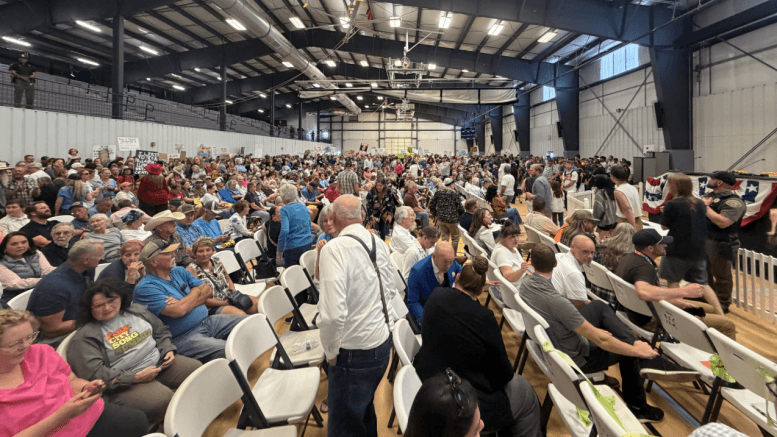
Hundreds of Box Elder County residents gathered May 4 at the fairgrounds for a commissioners’ vote on a massive data center project. (Photo: Ava Brown, KUTV Photojournalist)
On the night of May 4, 2026, the Box Elder County Commission in northern Utah voted to approve one of the most audacious infrastructure proposals in American history. The project, dubbed Stratos, would consume 40,000 acres of land — an area roughly two and a half times the size of Manhattan — to house a sprawling network of artificial intelligence data centers powered by a 9-gigawatt on-site energy complex. The face attached to this venture is Kevin O’Leary, the flamboyant Shark Tank investor known as “Mr. Wonderful.” But behind the celebrity branding lies a blueprint that should concern anyone paying attention to how infrastructure decisions in this country are increasingly being made without the consent of the people who live there.
The vote did not come quietly. Hundreds of residents packed commission meetings and courthouse hallways. They carried signs. They demanded answers. And when the vote came down, many of them left feeling that the process had been designed from the beginning to sidestep them entirely. They were right to feel that way.
One of the most revealing features of the Stratos approval was its velocity. Residents reportedly received just three days’ notice before the first commission hearing. Commissioners themselves acknowledged they had been handed the proposal at the last hour and told to move quickly. No completed environmental assessment. No traffic study. No biological survey. The customary mechanisms of public oversight — the ones that exist specifically to slow down decisions of this magnitude — were simply not in place.
This is not an oversight. This is a method.
When powerful infrastructure projects need to bypass the friction of democratic deliberation, speed becomes the primary tool. The faster a proposal moves, the less time an organized opposition has to form. The less time researchers have to scrutinize the fine print. The less time elected officials have to ask the inconvenient questions that might derail a deal worth billions of dollars. What happened in Box Elder County was a textbook illustration of how large-scale technocratic development works in practice: the decision was effectively made before the public meeting began, and the public meeting existed largely for the record.
Huh? The Military Installation Development Authority (MIDA)
Underlying the entire approval process is a legal structure that most Utah residents had never heard of before Stratos put it on the front page: the Military Installation Development Authority, or MIDA. Originally created by the Utah legislature to facilitate economic development adjacent to military installations, MIDA has a structural feature that makes it extraordinarily useful for projects that need to avoid conventional zoning review — it operates outside of county land-use authority.
That means that when MIDA shepherds a project through approval, local elected officials have limited power to block it, regardless of what their constituents demand. The state-appointed board, not the county commission, holds the decisive cards. It is no coincidence that O’Leary’s team chose to work through this channel rather than the standard permitting process. The MIDA structure functionally neuters local governance, converting what should be a public deliberation into an administrative transaction between the developer and a state authority insulated from electoral accountability.
This is not an abuse of the law. This is the law doing exactly what it was designed to do in this context, which is precisely what makes it dangerous.
The Water Question Nobody Can Answer
Utah is in a prolonged drought. The Great Salt Lake, one of the most ecologically significant bodies of water in the Western United States, is already critically low. Years of agricultural diversion, population growth, and changing precipitation patterns have reduced the lake to a fraction of its historical surface area. The exposed lakebed releases arsenic-laden dust into the Wasatch Front air. Entire species that depend on the lake’s brine shrimp ecosystem are under threat. This is not a background fact — it is the defining environmental crisis of the region.
Data centers drink water. They consume it in enormous quantities for cooling, and at the scale contemplated by Stratos, the consumption figures are staggering. Yet at the time the Box Elder County Commission cast its votes, no completed water-impact study existed. Residents raised this concern loudly and repeatedly. Proponents brushed the concern aside with assurances that water sourcing was being evaluated. But assurances are not studies, and studies are not binding commitments.
The absence of a completed water analysis before approval is not a procedural technicality. It is the most consequential unanswered question surrounding the entire project, and the commission voted anyway.
The Tax Structure Tells the Story
If there were any doubt about who this project is designed to benefit, the financial architecture dissolves it. To attract O’Leary’s investment, Utah’s MIDA board approved an energy transaction tax of 0.5%, compared to the standard rate of 6% — an 80% reduction. In addition, significant property tax rebates were negotiated on behalf of the developer.
Proponents argue that even reduced tax revenues from a project this large will generate substantial returns for the state, and they cite projections of $250 million annually in economic activity and up to 2,000 permanent jobs. These numbers deserve scrutiny. Data centers are capital-intensive but not labor-intensive. A 40,000-acre campus generating 2,000 permanent jobs is not a factory. It is a machine farm. The ratio of land consumed, water drawn, and public subsidy extracted to local employment created is deeply unfavorable for the surrounding communities.
The residents of Box Elder County are being asked to absorb the environmental and infrastructure costs of a development that will primarily enrich a Toronto-based investor and the institutional capital that follows him in.
National Security as a Shield
Proponents of Stratos have been careful to wrap the project in the language of national security. Commissioners were told that AI data centers of this scale are essential to maintaining American technological superiority over China. Utah Governor Spencer Cox echoed the same framing, calling the development “forward-thinking investment that strengthens our economy and supports national security.”
This framing is not entirely without merit. The United States does face real competition in artificial intelligence infrastructure, and the geographic and logistical requirements for building compute capacity at scale are legitimate concerns. But national security language has a well-documented history of being deployed to suppress public deliberation over projects that serve private interests. Once a development is framed as a matter of national defense, opposition becomes not merely inconvenient but vaguely unpatriotic.
The citizens of Box Elder County are not opposed to American technological competitiveness. They are asking where the water study is. Those are not the same thing, and conflating them is a rhetorical maneuver, not an argument.
What This Really Is
Strip away the celebrity branding, the national security framing, and the promise of tax revenue, and what remains is a familiar pattern: a large-scale technocratic infrastructure project designed to route around democratic accountability at the local level, approved at speed before public opposition could organize, on land that will be transformed beyond recognition, drawing resources from an already-stressed ecosystem, with the financial benefits flowing primarily upstream.
The residents who packed that courthouse in Box Elder County understood something important. They understood that the decision was not really theirs to make — that the legal architecture had been arranged in advance to ensure a specific outcome. What they may not yet fully appreciate is that this is not a Utah problem, or a Kevin O’Leary problem, or even a data center problem.
It is a governance problem. And it is accelerating.
The infrastructure of the artificial intelligence economy is being built right now, at speed, in places where land is cheap, oversight is thin, and state authorities can be positioned to override local resistance. Stratos is not an isolated case. It is a preview. The communities that will be affected most have the least power to stop it, and the political structures that should protect them have been quietly redesigned to facilitate exactly what happened in Box Elder County on the night of May 4, 2026.
Patrick Wood is a leading and critical expert on Sustainable Development, Green Economy, Agenda 21, 2030 Agenda and historic Technocracy. He is the author of Technocracy Rising: The Trojan Horse of Global Transformation (2015) and co-author of Trilaterals Over Washington, Volumes I and II (1978-1980) with the late Antony C. Sutton.