Japan has been headed into a demographic winter for decades and now the aging population has run out of younger nurses and aids to care for the elderly. Technocrats to the rescue. By 2030-2035, most elder tasks will be performed by robots including routine medical tasks, companionship, exercise, cooking, laundry and cleaning. ⁃ Patrick Wood, Editor.
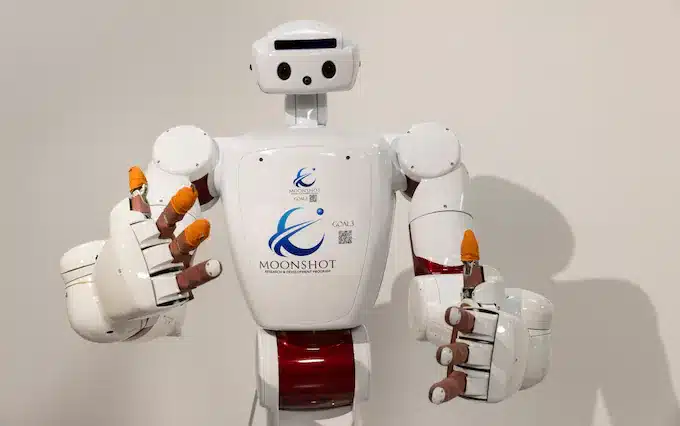
The robot slowly lifts its two arms and bows slightly. Its long padded fingers, which were made to look and function like a human’s, are extended.
“I am going to scan you now,” it says, as its eyes track from one end of the bed to the other, capturing every detail of my body.
The robot reaches down gently, positioning one mechanical hand under my shoulder and the other at my knee. It then rolls me from my back onto my side. It is a demonstration of one of many tasks that can be performed by the Airec caregiving robot, along with putting on socks and changing nappies.
Far from science fiction, robots could one day perform a vital role at a time of crisis in Japan, taking on critical care responsibilities for the oldest and most vulnerable members of society.
Airec – meaning AI-driven Robot for Embrace and Care – was developed by scientists at the Future Robotics Organisation (FRO) at Waseda University, Tokyo, specifically to care for the elderly as the country faced an acute demographic crisis.
Japan has one of the world’s oldest populations, with a record number of citizens aged 100 or older and almost a third of its population aged 65 or older.
Britain’s population is ageing fast, too: the number of people aged 80 or older is expected to double over the next 40 years, while the population of under-20s will decrease.
Many countries are facing a similar predicament, but few are as close to breaking point as Japan, which is not only battling a rapidly shrinking population, but also a steep decline in nurses and carers.
To solve the problem of a reduced caring workforce and an expanding elderly population, Japan’s government has turned to robots to make up the shortfall. It is funding scientists to explore automation as an alternative to human care-givers.
Despite the urgent need, would elderly people even want to be cared for by robots?
Several pensioners who spoke to The Telegraph said they were open to having a robot look after them in their old age, but they disliked the idea of it performing intimate tasks, such as bathing
We spent a week with Japan’s leading automation researchers and observed robots in action. Most malfunctioned in some way while performing critical tasks.
Airec, for example, struggled to locate my foot accurately when putting on a sock unless it was at a specific angle. With a population as vulnerable as the elderly, all issues must be fixed.
Terauchi Takashi, who manages Vihara Jujo nursing home in Kyoto, said: “The risk is high when caring for the elderly.
“For example, there is a specific amount of food that has to be given and at a specific pace, which varies from meal to meal. If anything goes wrong, an elderly person could choke and die.”
There is, though, still time: scientists do not expect robots to be in nursing homes or hospitals in Japan for at least a decade.
The building blocks
Developing a humanoid robot, especially one that will interact closely with humans, is extremely difficult. They need to move in a way that resembles humans, and touch and support people without causing harm.
In the care-giving field, robots need to be capable of anticipating human behaviour and responding accordingly, as well as correcting themselves if they make a mistake. In Japan, scientists have been using AI to teach and train robots.
Prof Shigeki Sugano, the director of the FRO, said: “By allowing the robot to practise 20 times, it can acquire the skill itself.”
He said it was not dissimilar to humans acquiring skills as they grow older, adding: “You show the robot how to roll someone to a certain angle on the bed.
“Once the robot has acquired the skill, you don’t even have to watch. The robot will be able to understand the bed, the person on it and how much force is required.”
However, huge amounts of data are needed. When it comes to elderly care, this means recording how humans move in their homes, when getting out of bed or cooking a meal, for instance. Some of the data can be collected using smart devices, such as motion sensors.
Scientists at the National Institute of Advanced Industrial Science and Technology (AIST) in Tokyo have also developed motion-capture technology that tracks how a person moves through a space.
Tsubasa Maruyama, a senior researcher at the Artificial Intelligence Research Centre at AIST, said this created a “digital human” that could be used to develop “personalised care plans and home robot assistance”.
However, the research is still in its early stages. Data collection is expected to start in 2027, with robots unlikely to be introduced into care homes until at least 2032 – and even then they would work alongside humans.
Many of the robots being developed for elderly care are humanoids, which scientists say is intentional for function and comfort. By having two arms and hands with fingers, the robot will be better able to perform tasks in the way a human would, and also less likely to frighten people.
Domae Yuyikasu, the team leader of AIST’s Automation Research Team, said: “If the robot looks like a human, people tend to be more relaxed about it, especially in the home-care environment. But if it gets too close to the human form, it can trigger fear because you don’t know what it is any more.”
The uncanny valley theory was developed by Masahiro Mori, a Japanese roboticist, in the 1970s to explain the revulsion humans felt when a robot appeared human.
A droid to fill the void
By 2050, scientists hope robots will be able to take on several responsibilities, physical and social.
The Future Robotics Organisation in Tokyo is focusing on tasks that are physically difficult for the elderly, but not too complicated – such as putting on socks and rolling someone onto their side to avoid bedsores.
Eventually, robots could assist with more challenging jobs, such as using the lavatory, lifting people from a bed to a wheelchair and bathing them in the shower. Beyond physical support and assistance, robots could also ease loneliness, which is known to be a health risk.
Takashi Hattori, the founder of XNova, an AI and robotics company in Kyoto, has developed a robot he believes could help. The Buddharoid is a monk robot programmed with Buddhist scripture in Japanese and English.
Mr Hattori said: “There are fewer monks and priests in Japan, so the Buddharoid can step in and offer spiritual and emotional support to communities like the elderly.”
He also noted that older and younger people often lived separately, and “robots could help reduce loneliness among the elderly”.
Unlike Airec, which was built in Japan, the Buddharoid came from China’s robot-building industry. Mr Hattori has programmed an existing model to hold conversations and offer spiritual guidance.
He explained: “In Japan, the temple is a place where people can connect, so if we can have a robot that can work as a monk, we can help to revive this sense of community.”
Friend or foe
However, Japan’s elderly and care-givers are torn on whether robots could ease the need for companionship – or exacerbate it.
Matsumi Deguchi, who runs the Higashi-Kujo Nozomi nursing home in Kyoto, believes robots could step in for humans when it comes to socialising.
She said: “Loneliness can decrease the desire to live so if we were to get a robot, our top priority would be for it to sit with the elderly, make conversation and serve as a companion.”
However, Yayoi Okamoto, 88, a nursing home resident in Kyoto, said that while she would be happy for a robot to take on certain physical tasks, that is all she would want it to do.
She said: “I often wake up during the night and there are things I want to ask the staff to help me with, but they always look so tired that I feel badly asking. If there was a robot helping me I wouldn’t feel bad because it doesn’t have feelings – but I could never see a robot as a companion.”
Mr Terauchi, from the Kyoto nursing home, added that while “robots can fill some of the space of a human”, people “will always need human-to-human interactions”.
Beyond companionship, there is also the question of whether the Japanese public would feel comfortable allowing a robot to take on something as intimate and important as personal care.
Prof Sugano believes robots will be accepted more quickly in Asia than in Europe, because of the way Buddhism and Shintoism include the belief that inanimate objects possess a spirit.
He said: “For example, if a child is playing with a stuffed animal and you throw it away or step on it, in Japan we would say, ‘Don’t do that, now the stuffed animal is crying’. In European countries, the reaction is that the stuffed animal is now broken.”
Scientists and care-takers are optimistic that the increasing use of technology, especially smart devices, will translate into a greater sense of ease around robots when they are eventually introduced into the mainstream.
However, despite the conflicting views and numerous challenges, those who make up Japan’s small pool of care staff see automation as an inevitability – and one that may as well be understood as best as possible.
Mr Terauchi added: “There are difficulties in using robots for elderly care, but we have a major problem because we have a shortage of people caring for the elderly. Using robots in this way is ultimately something we won’t be able to avoid.”
Patrick Wood is a leading and critical expert on Sustainable Development, Green Economy, Agenda 21, 2030 Agenda and historic Technocracy. He is the author of Technocracy Rising: The Trojan Horse of Global Transformation (2015) and co-author of Trilaterals Over Washington, Volumes I and II (1978-1980) with the late Antony C. Sutton.




![2021_One-Health-1200x675[60] (1)](https://www.technocracy.news/wp-content/uploads/2024/05/2021_One-Health-1200x67560-1-1-150x150.png "WHO Needs A Treaty? \"One Health\" Is Already Firmly Established In America")